
Local SEO: The Complete Guide to Dominating Google on the French Riviera in 2026
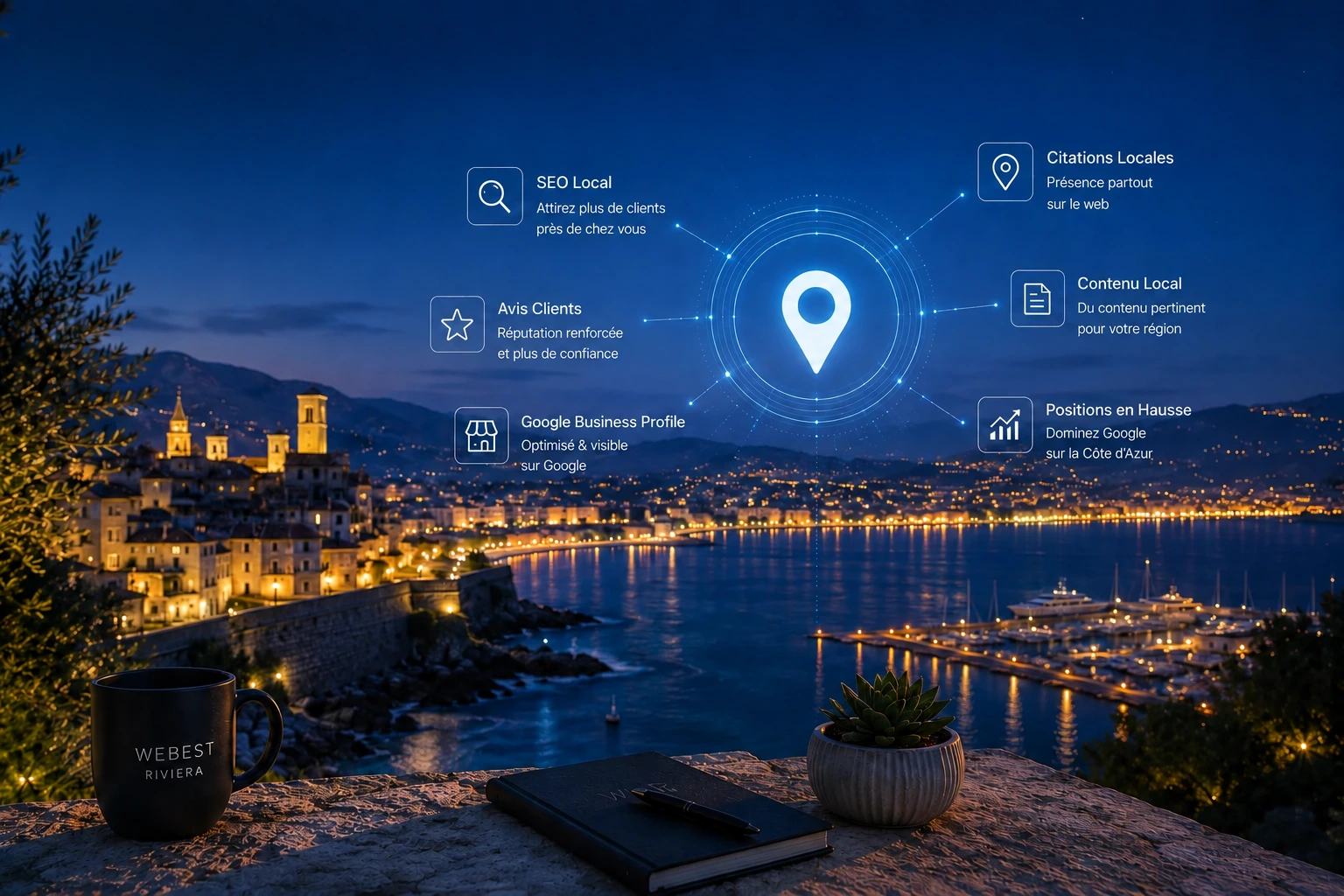
Local SEO follows a different logic from generic SEO: it’s not just about ranking for a keyword, but ranking for that keyword among people in a specific geographic area — and on the French Riviera, where the density of shops and service providers is particularly high, that battle is fought street by street, town by town.
Google Business Profile: the absolute baseline
Even before thinking about the website, a Google Business Profile listing is often the first point of contact between your business and a potential customer. An optimised listing includes:
- A precise category, matching your business exactly — not a generic one chosen for convenience.
- Recent, regular photos, showing an active business rather than an abandoned listing.
- Accurate, up-to-date hours, including public holidays and seasonal closures if any.
- Regular posts (offers, news, events), signalling real activity to Google.
- A consistent reply to reviews, positive and negative alike — no reply is just as visible as a bad one.
Customer reviews: an under-leveraged lever
The volume, freshness and average rating of reviews directly influence ranking in Google’s local pack — the map-topped area that appears above results for a geo-targeted search. A simple process for requesting reviews after each job (a link sent by text or email right after the work is done) radically changes the volume of reviews collected over time, compared to sporadic, improvised requests.
Local page structure: doing it right
This is where most web agency sites on the French Riviera fail, often without realising it: creating one page per city by simply swapping the town name in otherwise identical content. Google identifies this kind of duplicate content and implicitly penalises it, ranking it lower than genuinely differentiated content.
An effective city page should include:
- Genuine references to the local economy (yachting in Antibes, perfumery in Grasse, finance and luxury in Monaco).
- Unique content, not a template copy-pasted with the city name changed.
- Structured data (schema.org) explicitly stating the area served.
- A clear link to other service areas, strengthening the site’s internal linking.
This is exactly the approach we apply to our own city pages, from Nice to Monaco, through Antibes, Cannes, Menton and Grasse.
Local citations and NAP consistency
NAP stands for Name, Address, Phone. These three pieces of information must be rigorously identical everywhere your business appears online — your site, your Google listing, business directories, social media. Even a minor inconsistency (a phone number differing from one directory to the next) sows doubt in Google’s verification algorithms and weakens the trust placed in your listing.
Content that matches local search intent
The most qualified searches aren’t always the most generic ones. A query like “web agency available this week in Antibes” often converts better than a generic “web agency” search, precisely because it reflects immediate intent. Blog or service page content that directly answers these long-tail intents captures a smaller audience in volume, but one far more likely to act.
The technical work that supports local SEO
The best content in the world doesn’t compensate for a broken technical foundation. LocalBusiness or Service structured data helps Google precisely understand who you are, where you operate, and what you offer — we’ve built it into all of our own pages. Load speed also remains a direct ranking factor, even more decisive on mobile during a geo-targeted search.
SEO and SEA: complementary levers, not competing ones
Organic search takes time to pay off, but builds lasting, free visibility over the long run. SEA (Google Ads) delivers immediate visibility, billed per click, while organic SEO work builds up momentum. Businesses that intelligently combine both — SEA during launch or a slow period, ongoing SEO — generally get the best return on investment over time.
Measuring results without trusting impressions
A ranking that “feels” like it’s improving is no substitute for rigorous measurement. Google Search Console remains the free reference tool for precisely tracking impressions, clicks, click-through rate and average position for each of your target queries over time. We’ve built our own regular tracking on this basis — a practice we recommend to every client, whichever agency handles their SEO.
The mistakes that cost the most
- An abandoned Google Business Profile, with no posts or review replies for months.
- City pages with near-identical content, adding no real value for Google or for visitors.
- Ignored negative reviews, reinforcing the impression of an unresponsive business.
- A site that hasn’t evolved in years — content freshness remains a ranking signal Google takes into account.
Our approach at Webest Riviera
Local SEO is built into every site we deliver from the outset — not bolted on afterwards. You can explore our SEO service in detail, or get in touch for a free audit of your current situation.
In short
Local SEO on the French Riviera plays out on three fronts at once: an actively maintained Google Business Profile, content pages genuinely differentiated by geographic area, and a sound technical foundation that doesn’t hold content efforts back. Businesses that treat all three fronts with equal rigour build a lasting lead over competitors who, on the whole, still largely neglect this groundwork.
Frequently asked questions
What exactly is local SEO?
Local SEO covers all the techniques that let a business appear in geo-targeted search results — the three-result "map pack" at the top of Google searches, but also standard results for queries like "web agency + city." It combines an optimised Google Business Profile, dedicated content pages by area, and consistent business information across the web.
How long does it take to see results from local SEO?
The first effects on a Google Business Profile can show up within a few weeks. Organic ranking on content pages typically takes three to six months to settle in durably, and longer for highly competitive searches.
Does local SEO work differently in Monaco?
The principle stays the same, but Monaco's clientele is more international — well-optimised bilingual French/English content becomes a real advantage there, whereas it's secondary in a town like Grasse or Menton.
Do you need a dedicated page per city to rank well locally?
Yes, as long as each page has genuinely different content from the others — listing the same services with just the city name swapped adds almost no benefit, and can even read to Google as low-value duplicate content.
Do Google reviews really influence ranking?
Yes — volume, freshness and average rating of reviews are all signals factored into Google's local algorithm, on top of their obvious effect on the trust of visitors reading them before contacting you.
Ready to take your online presence further?